
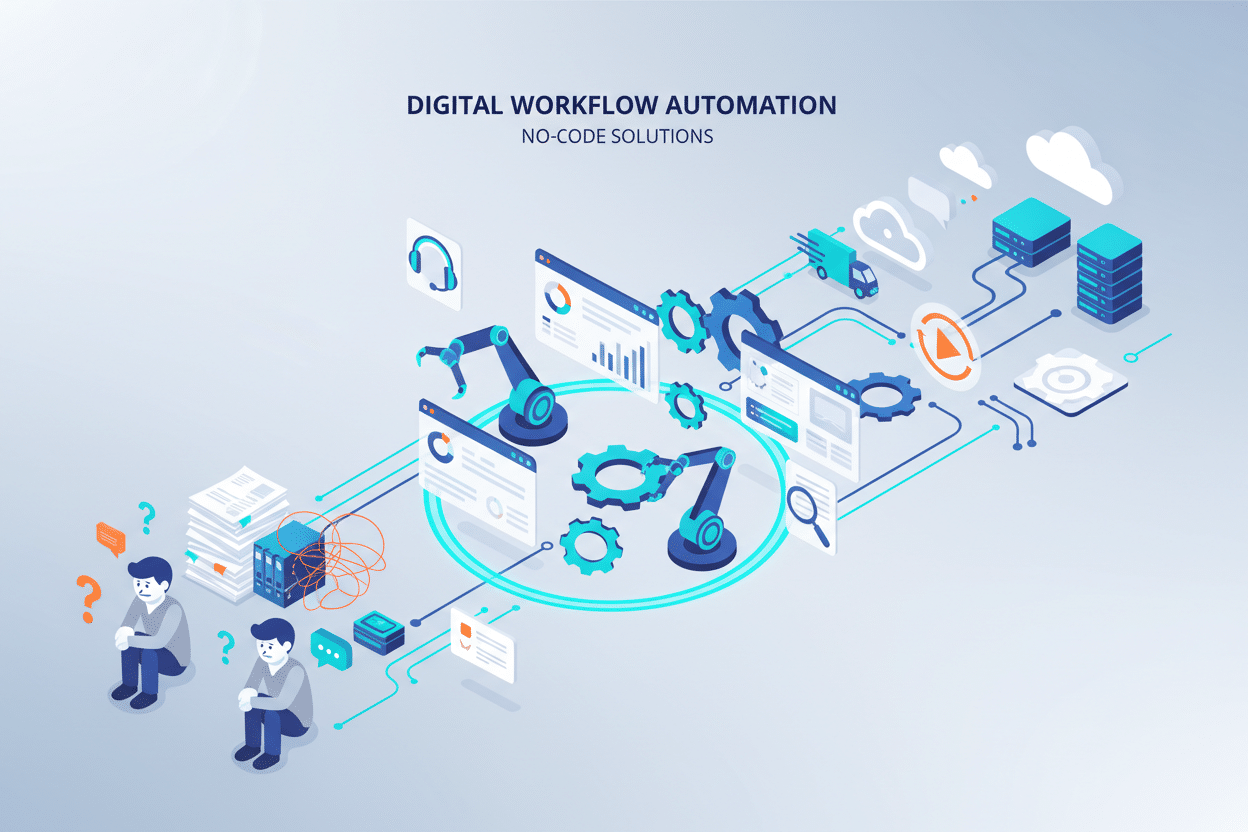
The Benefits of No-Code Automation for Enhancing Service Delivery 🚀
Table of Contents
1. Introduction to No-Code Automation
2. Understanding Service Delivery Challenges
3. Key Benefits of No-Code Automation for Service Delivery
4. Real-World Applications and Use Cases
5. Getting Started with No-Code Automation
6. Overcoming Common Implementation Hurdles
7. Future of No-Code in Service Delivery
8. Conclusion
9. Frequently Asked Questions
Introduction: Why No-Code Automation is Revolutionizing Service Delivery 💡
Remember the days when automating business processes meant hiring expensive developers, waiting months for implementation, and crossing your fingers that everything would work as intended? Those days are rapidly becoming a distant memory. Welcome to the era of no-code automation – where business professionals can create powerful automated workflows without writing a single line of code.
As someone who’s witnessed countless organizations struggle with manual processes and service delivery bottlenecks, I can confidently say that no-code automation represents one of the most significant shifts in how businesses operate today. It’s not just about making things faster; it’s about fundamentally transforming how we deliver value to our customers.
In this comprehensive guide, we’ll explore how no-code automation can revolutionize your service delivery, boost customer satisfaction, and give your team the superpowers they never knew they needed. Whether you’re a small startup or a large enterprise, the principles and benefits we’ll discuss apply universally.
Understanding Service Delivery Challenges in Today’s Business Landscape 📊
Before diving into solutions, let’s acknowledge the elephant in the room. Modern service delivery faces unprecedented challenges that would make even the most seasoned business professional break into a cold sweat.
Customer expectations have skyrocketed. They want instant responses, personalized experiences, and seamless interactions across multiple channels. Meanwhile, businesses are dealing with limited resources, increasing operational costs, and the constant pressure to do more with less. It’s like trying to juggle flaming torches while riding a unicycle – theoretically possible, but incredibly stressful.
Traditional manual processes simply can’t keep up. When your customer service team spends hours copying data between systems, or when simple approval workflows take days instead of minutes, you’re not just losing efficiency – you’re losing customers. The ripple effect of these inefficiencies touches every aspect of your business, from employee morale to bottom-line results.
This is where no-code automation steps in as the game-changer. It bridges the gap between what businesses need and what they can realistically achieve with their current resources.
Key Benefits of No-Code Automation for Service Delivery Excellence ⭐
Dramatically Reduced Response Times and Faster Resolution
The most immediate impact you’ll notice with no-code automation is speed – and I mean lightning-fast speed. Imagine transforming a process that typically takes your team 30 minutes into something that happens in 30 seconds. That’s not science fiction; that’s the reality of well-implemented automation.
When a customer submits a support ticket, automated workflows can instantly categorize the issue, assign it to the right team member, and even provide initial troubleshooting steps. This means your customers get faster responses, and your team can focus on complex problem-solving rather than administrative tasks.
I’ve seen companies reduce their average response time from 24 hours to under 2 hours simply by implementing smart ticket routing and automated acknowledgments. The impact on customer satisfaction scores is nothing short of remarkable.
Enhanced Consistency and Reduced Human Error
Let’s be honest – humans make mistakes. We forget steps, misplace information, and sometimes just have off days. While these human qualities make us creative and adaptable, they can wreak havoc on service delivery consistency.
No-code automation ensures that every customer receives the same high-quality experience, regardless of which team member handles their request or what time of day it arrives. Standard operating procedures become embedded in the workflow itself, making it virtually impossible to skip crucial steps or forget important follow-ups.
This consistency extends beyond individual interactions. Your entire service delivery process becomes predictable and reliable, which builds trust with customers and confidence within your team.
Improved Resource Allocation and Cost Efficiency
Here’s where no-code automation really shines from a business perspective. By automating routine tasks, you’re essentially giving your team members superpowers. They can handle more complex cases, take on strategic projects, and deliver higher-value services.
The math is compelling: if automation handles 60% of routine inquiries, your existing team can effectively serve 2.5 times more customers without compromising quality. That’s growth without proportional cost increases – every CFO’s dream scenario.
Moreover, the cost of implementing no-code solutions is a fraction of traditional custom development. You’re looking at weeks instead of months, thousands instead of hundreds of thousands, and immediate ROI instead of long payback periods.
Enhanced Customer Experience and Satisfaction Scores
Customer experience isn’t just about solving problems quickly – it’s about creating smooth, frustration-free interactions that make customers feel valued and understood. No-code automation excels at creating these seamless experiences.
Automated workflows can personalize communications based on customer history, proactively notify customers about order updates, and ensure consistent follow-up on outstanding issues. It’s like having a dedicated concierge for every customer, working 24/7 to ensure their needs are met.
The data speaks volumes: companies implementing comprehensive automation strategies typically see customer satisfaction scores increase by 20-30% within the first six months. That’s not just a number – that’s the foundation for long-term customer loyalty and business growth.
Real-World Applications: No-Code Automation in Action 🛠️
Customer Support and Help Desk Automation
Picture this scenario: A customer emails your support team at 2 AM with a billing question. Instead of waiting until business hours for a response, an automated workflow immediately acknowledges their inquiry, checks their account status, and provides relevant billing information or escalates complex issues to the appropriate specialist first thing in the morning.
Modern no-code platforms can integrate with your existing CRM, knowledge base, and communication tools to create sophisticated support workflows. These systems can handle password resets, account updates, basic troubleshooting, and even schedule callbacks – all without human intervention.
The beauty lies in the exceptions. When automation encounters something it can’t handle, it seamlessly hands off to human agents with complete context and background information. Your team spends their time on challenging, interesting problems while routine inquiries are resolved instantly.
Order Processing and Fulfillment Workflows
E-commerce and service businesses are discovering that order processing automation can transform their entire operation. From the moment a customer places an order, automated workflows can verify payment, check inventory, generate shipping labels, send confirmation emails, and update multiple systems simultaneously.
But it goes beyond basic processing. Smart automation can identify potential issues before they become problems – flagging unusual orders for review, automatically applying appropriate discounts, and even predicting delivery delays based on current logistics data.
One retail client I worked with reduced their order processing time from 4 hours to 15 minutes while simultaneously decreasing errors by 85%. The ripple effect improved everything from cash flow to customer reviews.
Appointment Scheduling and Management Systems
Service-based businesses often struggle with the back-and-forth of appointment scheduling. No-code automation transforms this pain point into a competitive advantage. Customers can book appointments 24/7, receive automated confirmations and reminders, and even reschedule without human intervention.
Advanced systems can optimize scheduling based on staff availability, service requirements, and customer preferences. They can automatically send preparation instructions, follow-up surveys, and even identify opportunities for additional services based on appointment history.
The impact extends to your team as well. Staff members receive optimized schedules, automatic notifications about changes, and can focus on service delivery rather than administrative coordination.
Getting Started: Your No-Code Automation Journey 🎯
Identifying Automation Opportunities in Your Service Delivery
The key to successful automation isn’t trying to automate everything at once – it’s identifying the right processes that will deliver maximum impact with minimal complexity. Start by mapping your current service delivery workflow and looking for patterns.
Ask yourself these questions: Which tasks do your team members repeat most frequently? Where do bottlenecks typically occur? What processes require the most manual data entry? Which customer interactions follow predictable patterns?
I always recommend starting with processes that are high-volume, rule-based, and currently causing frustration for either customers or staff. These are your quick wins that will build momentum and demonstrate value to stakeholders.
Choosing the Right No-Code Platform for Your Needs
The no-code landscape offers numerous options, each with unique strengths. Popular platforms like Zapier excel at connecting different applications, while tools like Microsoft Power Automate integrate seamlessly with existing Microsoft ecosystems. Newer players like Bubble and Webflow offer more comprehensive application-building capabilities.
Consider factors like existing software integrations, team technical comfort level, scalability requirements, and budget constraints. Most platforms offer free trials, so don’t hesitate to experiment with multiple options before making a commitment.
Remember, the best platform is the one your team will actually use consistently. Sometimes a simpler tool that everyone adopts is more valuable than a complex platform that sits unused.
Overcoming Common Implementation Challenges 💪
Managing Change Resistance and Team Adoption
Let’s address the elephant in the room – not everyone will immediately embrace automation. Some team members worry about job security, while others simply prefer familiar manual processes. This resistance is natural and manageable with the right approach.
Transparency is crucial. Clearly communicate that automation is designed to eliminate boring, repetitive tasks so team members can focus on more interesting, valuable work. Share specific examples of how automation will make their daily lives easier and more fulfilling.
Involve your team in the automation design process. When people help create solutions, they’re much more likely to support and use them effectively. Their frontline insights often lead to better automation designs anyway.
Ensuring Data Security and Compliance
Automation inevitably involves data movement and processing, which raises important security and compliance considerations. The good news is that reputable no-code platforms typically offer enterprise-grade security features, but you still need to implement proper governance.
Establish clear guidelines about what data can be automated, which integrations are approved, and how to handle sensitive information. Regular audits of automated workflows help ensure ongoing compliance and identify potential security gaps.
Consider working with your IT and compliance teams from the beginning. Their early involvement prevents problems and builds organizational confidence in your automation initiatives.
The Future of No-Code Automation in Service Delivery 🔮
We’re still in the early stages of the no-code revolution. Artificial intelligence integration is making automation smarter and more adaptive. Machine learning algorithms can now optimize workflows based on historical performance, predict customer needs, and even generate automated responses that sound increasingly human.
The convergence of no-code tools with AI, IoT devices, and advanced analytics promises even more sophisticated automation possibilities. Imagine service delivery systems that proactively identify and resolve issues before customers even notice them.
Voice interfaces, augmented reality integration, and blockchain-based verification are just a few emerging technologies that will expand automation capabilities. The businesses that start building no-code competency today will be best positioned to leverage these advanced features as they become available.
Conclusion: Embracing the No-Code Advantage for Superior Service Delivery 🎉
No-code automation isn’t just a trendy technology – it’s a fundamental shift in how businesses can deliver exceptional service without exponential cost increases. The benefits we’ve explored – faster response times, improved consistency, better resource allocation, and enhanced customer satisfaction – represent just the beginning of what’s possible.
The most successful organizations won’t be those with the biggest budgets or the most technical expertise. They’ll be the ones that embrace no-code automation to augment human capabilities, eliminate friction from customer interactions, and create service delivery experiences that competitors struggle to match.
Your journey toward automated service excellence doesn’t require a massive transformation overnight. Start small, learn continuously, and build momentum through early wins. The tools are available, the benefits are proven, and your customers are waiting for the improved experiences that automation makes possible.
The question isn’t whether no-code automation will transform service delivery – it’s whether your organization will lead that transformation or struggle to catch up. The choice, and the opportunity, is yours.
Frequently Asked Questions About No-Code Automation for Service Delivery ❓
Q: How long does it typically take to implement no-code automation for service delivery?
A: Implementation timelines vary based on complexity, but most businesses see initial results within 2-4 weeks. Simple workflows like automated email responses can be set up in hours, while comprehensive service delivery automation might take 2-3 months to fully deploy and optimize.
Q: Do I need technical skills to create automated workflows?
A: No technical coding skills are required, but basic computer literacy and logical thinking help. Most no-code platforms use visual, drag-and-drop interfaces that business professionals can learn quickly. Many organizations successfully implement automation using existing staff with minimal training.
Q: What’s the typical ROI for no-code automation in service delivery?
A: Most businesses see ROI within 3-6 months, with some achieving payback in weeks. Common returns include 30-50% reduction in response times, 20-40% decrease in operational costs, and 15-25% improvement in customer satisfaction scores. Specific ROI depends on current process efficiency and automation scope.
Q: Can no-code automation integrate with existing business systems?
A: Yes, modern no-code platforms offer extensive integration capabilities with popular business tools like CRM systems, email platforms, databases, and communication tools. Most platforms provide pre-built connectors for common applications, making integration straightforward without custom development.
Q: What happens if the no-code platform experiences downtime?
A: Reputable no-code platforms maintain high uptime standards (99.9%+) and provide backup systems. However, it’s important to have contingency plans for critical processes. Many businesses implement hybrid approaches where automation handles routine tasks while maintaining manual backup procedures for essential operations.
Q: How do I measure the success of my service delivery automation?
A: Key metrics include response time reduction, resolution rate improvements, customer satisfaction scores, cost per interaction, and employee productivity measures. Most no-code platforms provide built-in analytics, and you can track business metrics through your existing reporting tools to demonstrate automation impact.
Click Here For More Details